 Cinque Terre City Guide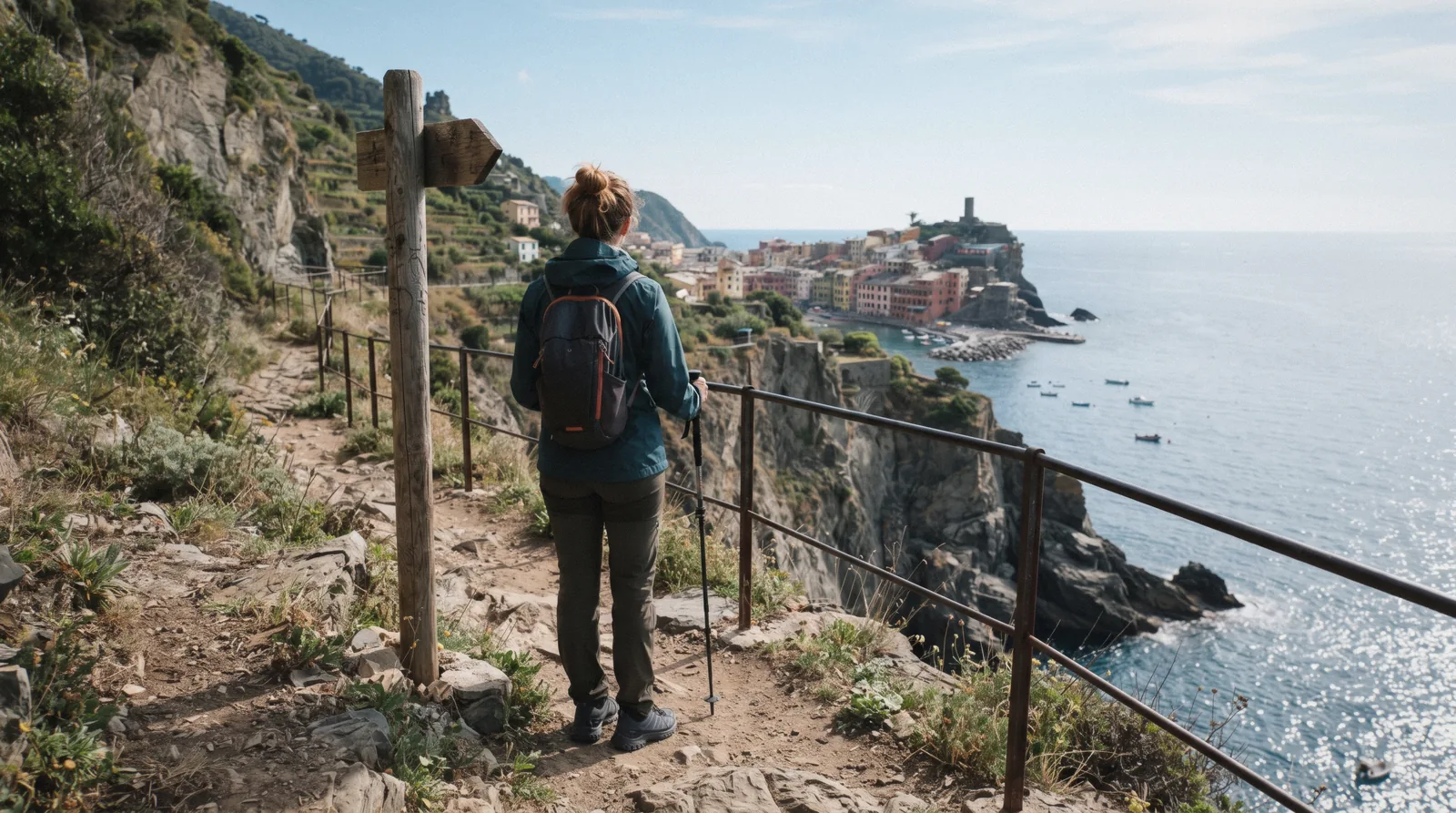
Is Cinque Terre Safe? Flip-Flop Fines, Trails and Emergency Numbers
Is Cinque Terre safe? For a small tourist area with low crime, yes, and the real hazards worth knowing are practical, not criminal: the trail footwear rule, exposed cliff edges, small train platforms, sudden autumn storms and the fact that no village has a hospital. This page covers each one plainly, including what we could not confirm from an official source.
Quick answer
Yes, the Cinque Terre is safe. Crime is low in this small tourist area. The real risks are practical: fines reported from $56.80 (€50) up to $2,841.80 (€2,500) for wearing flip-flops on park trails, exposed cliff-edge paths, fast trains at small stations, and flash floods. Check trail conditions before you set out, wear closed shoes with grip soles, and know that no village has its own hospital. For the full picture, start with our Cinque Terre guide.
Key takeaways
- The flip-flop and open-sandal ban on park trails carries fines reported from $56.80 (€50) to $2,841.80 (€2,500). See the Cinque Terre hikes guide for which trails it covers.
- No village has a hospital, the nearest emergency department is in La Spezia, and 112 works anywhere in Italy.
- Trail closures after storms are not optional, even with a Cinque Terre Card. The park closes segments and the card does not override that.
Is the Cinque Terre Safe
Short answer: yes, with a few specific things to take seriously.
Crime is not the issue
The five villages are small communities that live largely on tourism. Petty theft exists wherever crowds gather, but no crime statistic for the area is published in the sources used for this guide and we will not invent one. Ordinary care with bags and phones is enough.
The coast has been a UNESCO World Heritage site since 1997 and a national park since 1999, and both statuses bring active management rather than neglect.
The real risks are environmental and logistical
What actually causes trouble here is rarely crime. It is the wrong shoes on a steep path, standing too close to a platform edge as a train passes, ignoring a storm closure, or needing an ambulance in a village with no hospital. Each of these has a simple, known answer, which is what this page covers.
None of it should put you off visiting. Plan the practical details with our Cinque Terre in 1 day itinerary and read about the Sentiero Azzurro before you commit to the coastal path.
Trail network and UNESCO status per parconazionale5terre.it and whc.unesco.org.
The Flip-Flop Rule and Reported Fines
This is enforced on the ground, not a rumor.
The footwear ban since 2019
Since 2019 the Cinque Terre National Park has banned flip-flops and open sandals on its hiking trails. The rule covers any open or flat-sole footwear, including slides and thin beach sandals, not just the classic flip-flop. Closed shoes with non-slip, grip soles are required on every numbered trail in the park, from the easy Via dell'Amore to the Esperto-graded segments.
Light trekking shoes, trail runners or sturdy sneakers all qualify, so there is no need to pack heavy hiking boots for this coast. The reason is simple: the paths are narrow, steep and rocky in places, and people in sandals slip, twist ankles and sometimes need rescuing from ground a properly shod walker crosses without incident.
How much is the fine
Fines reported in the Italian press range from $56.80 (€50) up to $2,841.80 (€2,500), depending on the trail section and the level of risk created by the footwear. One honest caveat: the fine range comes from independent Italian press reporting on the 2019 ordinance, not from the park's own published ordinance text, which was not located during research for this page. The existence and enforcement of the footwear ban itself is not in doubt, only the exact wording of the penalty schedule as written.
Treat the low end of that range as the realistic outcome for a first-time tourist stopped in open sandals, with the high end reserved for repeat or more serious cases.
Enforcement is real
Park staff check footwear on the trails and turn people back or fine them on the spot. This is not a rule that exists only on a sign at the trailhead. If you arrive in sandals planning to walk between villages, you will either buy proper shoes first, at one of the shops in the larger villages, or take the train instead and skip the trail entirely for that day.
Staff are generally reasonable about it. Anyone who shows up in the wrong shoes gets turned back rather than fined outright on a first encounter, though that is not a guarantee and should not be relied on as one. Learn more about the park and its rules on our Cinque Terre National Park page.
Fine range reported in Italian press coverage of the 2019 park ordinance, not the park's own published text.
Trail and Cliff-Edge Safety
The coastal path is beautiful and, in parts, exposed.
Exposed sections and expert grading
The coastal trail network runs along cliff edges in places, with narrow tread, steps carved into rock and long drops to the sea. Two segments are graded Esperto, which means expert: 592-3 from Corniglia to Vernazza (about 1h30) and 592-4 from Vernazza to Monterosso (about 2 hours). These are demanding routes with steep, uneven ground.
The easier coastal sections include 592-1, the Riomaggiore to Manarola stretch known as the Via dell'Amore (about 25 minutes, graded Turistico) and 592-2 from Manarola to Corniglia (about 1h15). Compare all of them in our Cinque Terre hikes guide.
Closures after storms
The park closes trail segments after storms, for maintenance and for crowd management, and the Cinque Terre Card does not override a closure. A card gets you onto open trails. It does not open a closed one.
Never hike a path marked closed. The barriers and signs exist because rockfall and washed-out tread are real hazards here, not decoration. Check the official trail status before setting out and read our Via dell'Amore page for that path's booking rules.
Simple trail habits
Wear the closed grip-sole shoes the park requires on every segment, not only the harder ones. Carry water, since fountains are not guaranteed along the way. Start early so you are not descending a cliff path in fading light, and build in extra time for photo stops, since the trail moves slower than it looks on a map.
Keep children close on the exposed sections and hold hands where the path narrows. Turn back if weather turns, rather than pushing on to finish a segment you already started. The park's Info Points at the main stations post current conditions, and the trail status page online is updated as things change through the day.
Train Platform Safety
The trains are the safest way between villages, but respect the platforms.
Small stations, fast trains
The five village stations are small and narrow, often cut into rock or squeezed between tunnels on both sides. Trains pass through some of them at speed even when they are not scheduled to stop there, and there is little warning beyond a short announcement. The gap between the platform edge and the track is small, and on the busiest platforms there is often little room to step back comfortably, especially with luggage or a stroller.
Our Cinque Terre train guide covers timetables and tickets for the same line, worth reading alongside this page before your first ride.
Stand back from the edge
Stand well back from the platform edge while waiting, hold children by the hand, and step behind the yellow line or against the station wall as a train approaches. To be plain about what we know: there is no Cinque Terre-specific published statistic on platform incidents that we can cite, and we will not invent an incident count. Standing back is standard Italian rail safety practice at any station, and it matters more here simply because the platforms are narrow and the trains are frequent in season.
Watch the crowds
In peak season, whole tour groups board and alight at once, and a platform that felt spacious a minute earlier can suddenly feel crowded right as a train pulls in. Let people off first before you try to board, mind the step between the train and the platform, which is not always level, and keep your bag in front of you rather than on your back in a crush. If you miss a train, another one comes soon in season, since the line runs frequently, so there is no real reason to rush onto a crowded platform or push past other passengers to make one specific departure.
Weather, Flash Floods and the 2011 Flood
The coast is prone to sudden, intense autumn rainfall, and the 2011 flood shows why warnings are taken seriously.
The flood of 25 October 2011
On 25 October 2011 torrential rain triggered flash floods and mudslides across Vernazza and Monterosso al Mare. Nine people were killed across the affected area. In Monterosso, damage to homes and businesses in the historic centre was estimated at about $42.06 million (€37 million), and the parish church of San Giovanni Battista flooded with more than 2 metres of water and mud.
In Vernazza, the railway station was buried under mud and debris. The events of that day are remembered in both villages, and our Vernazza flood 2011 page tells the story in detail.
Why this matters to you now
The terrain that made the 2011 flood so destructive has not changed. Steep hillsides, narrow valleys and streams that run through the middle of villages mean heavy rain can turn dangerous fast, sometimes within an hour of the first warning. This is why trail and Via dell'Amore closures after storms are taken seriously by park staff rather than treated as bureaucratic caution.
Autumn is the wettest time of year on this coast, which is also, awkwardly, one of the more popular seasons to visit, so the closures and the crowds who trigger them tend to arrive together.
Practical weather habits
Check the forecast on our Cinque Terre weather page before setting out to hike, and do not walk the coastal trails during or right after heavy rain, even if a segment shows as open. If an intense storm starts while you are in a village, move away from stream beds, underpasses and other low points, and follow any instructions from local staff or signage rather than trying to reach your accommodation directly. Ferries stop running in rough seas without much notice, so if your plan depends on one, keep the train as a backup for the same day.
Flood facts from Italian Wikipedia's account of the 25 October 2011 event.
Hospitals and Emergency Numbers
Know this before you need it: the villages have pharmacies and first aid, but no hospital.
Call 112
112 is the single EU-wide emergency number and works throughout Italy, including the Cinque Terre, for police, fire or ambulance, all through the same line rather than separate numbers. Save it in your phone before you travel rather than searching for it under stress. Operators can generally handle calls in English, though speaking slowly and giving your village name clearly at the start of the call helps them route it correctly, since the five villages sit close together and a name mispronounced under pressure can send help to the wrong platform or street.
No village has a hospital
None of the five villages has a hospital. The nearest hospital emergency department is in La Spezia, the main town at the south end of the rail line. To be transparent: a specific hospital name, address and emergency-department hours were not confirmed on an official page during research for this guide, so we state the practical fact rather than guess.
La Spezia is the reference town for serious medical care, reachable by train or ambulance from any of the villages. For routine needs, the villages have pharmacies, and pharmacists are a good first stop for minor problems.
Planning around this
If you travel with a condition that needs rapid hospital access, consider staying in La Spezia or Levanto rather than in one of the five villages, or at minimum know the train timetable for your return before you set out for the day. Carry any medication you need with you on hikes rather than leaving it at your accommodation, since a trail closure or a missed train can turn a short outing into a much longer one. Travel insurance that covers ambulance transfer is worth having anywhere in Italy, and it matters slightly more here given the distance to the nearest hospital.
Hospital name and address not confirmed on an official page in this research pass.
Water Safety on Boats and Beaches
The sea looks calm and usually is, but plan for it.
Beach lifeguards: an honest gap
No official source used for this guide publishes lifeguard status, beach safety flags or drowning statistics for any Cinque Terre village beach. We state that plainly rather than invent a rating. Treat village beaches as unsupervised unless you see a staffed post on the day.
Monterosso's Fegina district has the widest sandy beaches on this coast, while the other villages have small rocky coves, where entry into the water means rocks and deeper water close to shore. Read more in our Monterosso al Mare guide.
Tours with their own limits
Bookable boat and kayak tours carry stated participant limits that act as basic safety screening for small-boat activity. The Monterosso boat tour with aperitif does not accept riders over 95 or under 13. The Monterosso kayak and snorkeling tour is off-limits to children under 6 and capped to swimmers under 220 lbs.
These limits exist because small boats and kayaks demand a minimum level of strength and swimming ability, not to exclude anyone arbitrarily. For families weighing options, see our Cinque Terre with kids page.
General sea sense
Swim where others are already swimming rather than trying a spot that looks quiet but unfamiliar, and avoid alcohol before getting in the water, especially around rocks. Watch the wind. Afternoon onshore wind can raise a chop quickly in the small coves, turning an easy swim into a harder one within twenty minutes.
Jellyfish appear at some point most summers along this coast, usually in patches rather than everywhere at once. If you are unsure about conditions on a given day, ask at a dive or kayak stand near the water or simply stay out and try again tomorrow.
Age/weight limits from the tour operators' own listed descriptions.
Cinque Terre weather
Month-by-month conditions, including the wet autumn season.
Is the Cinque Terre safe for solo travelers?
Yes. It is a low-crime tourist area with frequent trains and plenty of other visitors, so solo travel is common and straightforward. The practical precautions are the same as for anyone: proper shoes on trails, care on platforms, and awareness that no village has a hospital.
Why can't you wear flip flops in the Cinque Terre?
The national park has banned flip-flops and open sandals on its trails since 2019 because people slip and need rescuing on steep, rocky ground. Closed shoes with grip soles are required. Fines reported in the Italian press range from $56.80 (€50) to $2,841.80 (€2,500), and park staff do enforce the rule on the trails.
Is there a hospital in the Cinque Terre?
No. None of the five villages has a hospital. The nearest hospital emergency department is in La Spezia, the main town at the south end of the rail line. A specific hospital name and address were not confirmed on an official page in our research, so plan around the fact that La Spezia is the reference town. Call 112 in any emergency.
What happened in the Cinque Terre flood in 2011?
On 25 October 2011 torrential rain caused flash floods and mudslides in Vernazza and Monterosso al Mare. Nine people died across the affected area. Monterosso's damage was estimated at about $42.06 million (€37 million) and Vernazza's railway station was buried in mud. It is the reason post-storm trail closures are treated seriously.
Are the Cinque Terre trails dangerous?
The easier coastal sections are manageable for anyone in reasonable shape wearing proper shoes. Two segments are graded Esperto, meaning expert: 592-3 from Corniglia to Vernazza and 592-4 from Vernazza to Monterosso. The main hazards are exposed cliff edges, uneven ground and attempting closed trails. Check the trail status page before you set out.
What number do I call in an emergency in the Cinque Terre?
Call 112. It is the single EU-wide emergency number and works anywhere in Italy for police, fire or ambulance. Give your village name and location clearly and stay on the line.
Prices, hours and terms are set by the venue or operator and confirmed at checkout.
We may earn a commission if you book through one of our links, at no extra cost to you. Full affiliate disclosure