 Cinque Terre City Guide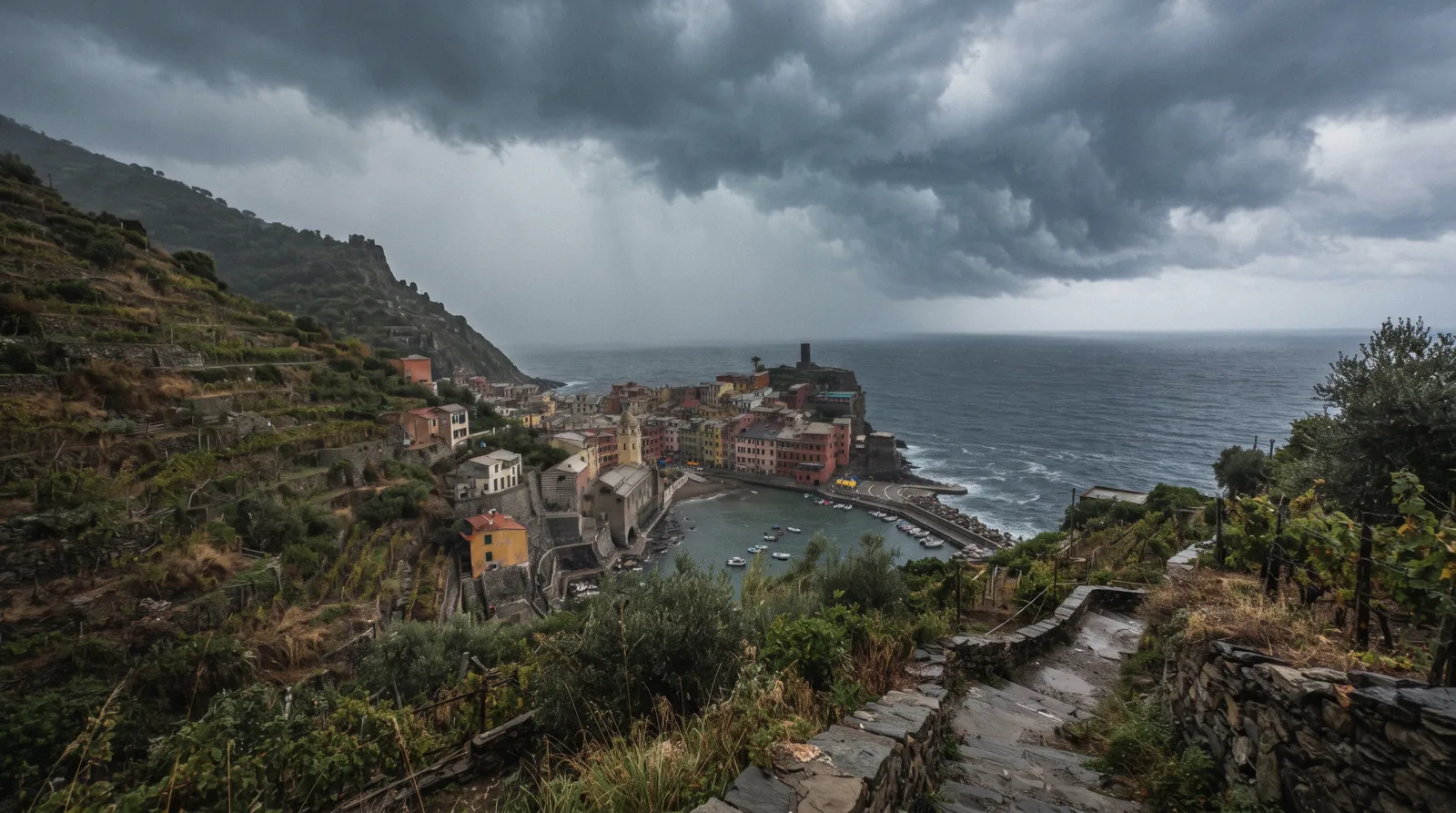
Cinque Terre Weather: The Coast Month by Month
The Cinque Terre runs on one coastal climate, not the split valley-and-summit weather of an Alpine village, but the numbers still decide the day. Average daily highs run from 10.9C (52F) in January to 27.4C (81F) in August, and rainfall swings from 42mm in July to 194mm in October and November. A clear morning at the station says nothing about whether a trail stays open by afternoon. This Cinque Terre weather page gives the real monthly figures, then explains what they decide: which trails close, whether the ferry sails, and what to pack. Trail closure notices come from the park's own trail status page. For what a day costs once the card and the weather are settled, see what the Cinque Terre costs. For the wider trip, start with our Cinque Terre guide.
Quick answer Cinque Terre weather in one paragraph
July is the driest month in the Cinque Terre with 42mm of rain and 6.6 rainy days, while October and November each average 194mm, and daily highs range from 10.9C (52F) in January to 27.4C (81F) in August.
Key takeaways
- The summer months of June, July and August combine the highest temperatures with the least rain. July averages just 42mm and August peaks at 27.4C (81F), which is why trails and trains are at their busiest then. Plan ahead with our best time to visit Cinque Terre breakdown.
- Autumn is the wettest stretch of the year. October and November each average 194mm of rain, and the park closes trail sections after storms, so build flexibility into any hiking plan. The Cinque Terre card does not override a weather closure.
- Spring sits between the extremes, with April at 109mm and May at 110mm, mild highs of 16.7C (62F) and 20.4C (69F), and long ferry and train seasons. See how the seasons compare across Cinque Terre, Italy.
- Winter is cool rather than freezing, with January lows of 5.9C (43F), and it is far from the wettest time of year. Manarola lights its hillside nativity scene and the villages slow down. Start with the Cinque Terre guide for the full picture.
Temperature and Rain by Month
These figures come from the ERA5 reanalysis for 1995 to 2024, taken at the Cinque Terre coast grid cell. They are thirty-year averages, not forecasts, so any single day can sit well outside them.
August is the warmest month at 27.4C (81F) and July the driest at 42mm, while October and November are the wettest at 194mm each, the same pattern our best time to visit Cinque Terre page works into a season-by-season plan.
Rainfall and Rainy Days, Month by Month
This table compares average monthly precipitation in millimetres with the average number of days recording measurable precipitation, both from the ERA5 reanalysis for the coast, 1995 to 2024. It answers a simple question: how often does rain actually shape the day?
| Month | Precipitation | Rainy Days |
|---|---|---|
| January | 128 mm | 11.6 |
| February | 112 mm | 10.5 |
| March | 111 mm | 11.3 |
| April | 109 mm | 12.5 |
| May | 110 mm | 12.4 |
| June | 72 mm | 9.4 |
| July | 42 mm | 6.6 |
| August | 58 mm | 8.0 |
| September | 115 mm | 10.1 |
| October | 194 mm | 12.7 |
| November | 194 mm | 14.2 |
| December | 152 mm | 12.8 |
October and November tie as the wettest months by volume, but November records the most rainy days of any month at 14.2. July is both the driest and the sunniest, with just 6.6 rainy days. Figures current in Q3 2026.
Reading the Month by Month Chart
The chart above compresses a year of weather into twelve bars. Here is what those numbers mean on the ground.
The Hot, Dry Summer From June to August
Summer is the most reliable stretch of weather on this coast. June reaches an average high of 24.3C (76F), July 27.0C (81F) and August 27.4C (81F), the hottest month of the year. Rainfall falls away at the same time, from 72mm in June to 42mm in July, the driest month, and back up slightly to 58mm in August.
Rainy days drop too, from 9.4 in June to 6.6 in July. The trade-off is crowds. This is the same window when the Cinque Terre Express reinforced train service runs at full strength on the Levanto-La Spezia line and when the ferry network carries its heaviest load, so the best weather brings the most people onto the same narrow paths.
Early starts, booked time slots and a little patience matter more in August than in almost any other month. For a month-by-month comparison of crowds and conditions, see our guide to the best time to visit the Cinque Terre.
The Two Wet Peaks, Spring and Late Autumn
Rain does not arrive in a single season here. It comes in two waves. The spring wave is gentler: April averages 109mm and May 110mm, with 12.5 and 12.4 rainy days, but temperatures are climbing, with highs of 16.7C (62F) in April and 20.4C (69F) in May.
Showers pass and the day often recovers. The autumn wave is heavier and more disruptive. October and November each average 194mm, the wettest months of the year, with November recording 14.2 rainy days, the most of any month.
These are also the months most likely to bring trail closures, because the park closes sections after storms and keeps them shut until they are safe. September sits on the edge, with 115mm and a pleasant high of 23.5C (74F), but the trend worsens from there. If you plan to hike in October or November, keep a rest day in reserve.
Our page on Cinque Terre hikes explains which trails are most exposed.
The Quiet Winter From December to March
Winter is the coolest season but not the wettest. December brings 152mm, then rainfall eases to 128mm in January, 112mm in February and 111mm in March. Temperatures stay mild for the latitude, with January highs of 10.9C (52F) and lows of 5.9C (43F), and March reaching 13.9C (57F) by day.
What changes most is what is open. The ferry drops to a reduced winter timetable in early November and stops entirely after early December, with no published schedule for the rest of December through February. The Manarola nativity scene, the illuminated hillside display started by Mario Andreoli in 1961, is lit through the Christmas season and gives the dark evenings a focus.
Winter suits travellers who want the villages to themselves, short daylight hours and quiet terraces. It is a completely different trip from August, and for many people a better one. Read our full Cinque Terre guide to plan a low-season stay.
What the Weather Decides
Weather in the Cinque Terre is not small talk. It decides which trails you can walk, whether the ferry sails and what you should wear on the stone paths.
Trail Closures and the Rules That Come With Rain
Weather does not just make a hike unpleasant on this coast. It can close the trail. The park shuts sections of its path network after storms, for maintenance and for safety, and a Cinque Terre card does not override a closure.
This is a standing rule, not a one-off, so a wet October day can cancel plans you paid for. Rain also changes what you should wear. Since 2019 the park has banned flip-flops and open sandals on its trails, with reported fines from US$56.80 (€50) to US$2,841.80 (€2,500).
Wet stone paths make the rule matter more in the rainy months, from October and November through to March. Closed shoes with a grip sole are the sensible minimum at any time of year, but especially when the ground is damp. Check the park's trail notices the evening before you set out, and have a village-based plan B ready.
Our safety page covers trail conditions in more detail.
What the Ferry Season Has to Do With the Weather
The ferry run by the Consorzio Marittimo Turistico Cinque Terre - Golfo dei Poeti is a seasonal service, and the calendar narrows as the year cools. The main season runs from late April to late September, with a shoulder season on either side in spring and autumn, and a reduced winter timetable into early December. After that, no schedule is published for the rest of December through February, so weather aside, there are simply no boats in deep winter.
Rough seas can also stop sailings within the season itself, which is worth remembering when autumn storms push 194mm of rain into October and November. One thing the weather never changes is Corniglia. It has no ferry pier at any time of year because the village sits about 100m above the sea, so nobody arrives there by boat in any month or any conditions.
Trains and trails are the only ways in. Our ferry page lists the seasonal windows.
The Sea Temperature Gap, and What Your Card Is Worth
One number this site will not give you is a monthly sea temperature. No official source publishes one for this coast, and we would rather say so than invent a figure. Swimmers make their own judgement, and in practice people swim informally off the beaches and rocky coves at Monterosso al Mare, Vernazza, Manarola and Riomaggiore through the warm months, with August highs of 27.4C (81F) on land.
Treat any precise sea-temperature figure you find elsewhere with suspicion. The other constant is price. The trekking card costs US$11.37 (€10) a day and the Treno MS train and trail card costs US$25.00 (€22) a day, and neither changes with the weather.
What changes is what the card can actually be used for that day, because closed trails and stopped ferries reduce its value. Check conditions before you buy. Our costs page puts the cards alongside everything else you will spend.
Weather-Proof and Weather-Dependent Bookings
A boat or a hike is a bet on the sky, since a storm can cancel either. A cooking class runs indoors regardless of what the coast is doing outside.
 from $74.00
Vernazza: Pesto Making Class with Wine and Food Tasting
Cinque Sensi's class in Vernazza pairs a hands-on pesto lesson with three local wines and a plate of cheese and focaccia. Book the lunchtime slot to add gnocchi made with your own pesto, plus a liqueur and chocolate to close.
Check Availability from $79.00
La Spezia: Cinque Terre Tour by Boat to Riomaggiore and Monterosso
With over 3,400 reviews this is the most-booked boat tour out of La Spezia: an 8-hour return ferry with a guide aboard, choosing either a Portovenere-Monterosso-Vernazza route or a Riomaggiore-Monterosso-Vernazza one. It is not wheelchair accessible.
Check Availability from $91.00
La Spezia: Cinque Terre Guided Hiking Tour, Manarola to Corniglia
Shore Emotion leads a 3-hour trek along the coastal path from Manarola to Corniglia, with the Cinque Terre Card for the connecting trains built into the price. It rules out children under 8 and anyone with heart or back problems, since the path is uneven in places.
Check AvailabilityCard prices are the platforms' own listed US-dollar figures.
Prices, ratings and details are the platform's own. Dollar figures are the listed prices. The platform bills in your account's currency.
Cinque Terre Weather Questions
What is the best month for weather in the Cinque Terre?
For dry, warm days, July is hard to beat. It is the driest month of the year with 42mm of rain and only 6.6 rainy days, and the average high is 27.0C (81F) with a low of 20.7C (69F). The catch is that the best weather coincides with the biggest crowds on the trails and trains. June and September are good compromises, with June at 72mm of rain and a high of 24.3C (76F), and September at 115mm and a high of 23.5C (74F). Compare every month in our best time to visit the Cinque Terre guide.
Is it cold in the Cinque Terre in winter?
Cold by Ligurian standards means roughly 11C by day, not snow. January, the coolest month, averages a high of 10.9C (52F) and a low of 5.9C (43F), and February is nearly identical at 11.5C (53F) and 5.9C (43F). You will want a warm layer and a rain shell, since December brings 152mm of rain. What winter offers instead is quiet villages and the illuminated nativity scene on the hillside at Manarola. The ferry does not run in deep winter, with no published schedule from early December through February. Start planning with our Cinque Terre guide.
Does it rain a lot in the Cinque Terre?
It depends entirely on the month. October and November are the wettest, tied at 194mm each, and November has the most rainy days at 14.2. December is also wet at 152mm. At the other end, July manages just 42mm over 6.6 rainy days. Spring sits in the middle, with April at 109mm and May at 110mm, usually in showers rather than all-day rain. Because storms can close trails, autumn hikers should keep their plans flexible and check park notices. Our hiking guide explains how closures work.
What happens to the trails in bad weather?
The park closes trail sections after storms, for maintenance and for safety, and a paid card does not override a closure. This is a standing rule, so check trail status before setting out in any wet month, especially October and November with their 194mm averages. Rain also makes the stone paths slick, which is why the park has banned flip-flops and open sandals since 2019, with reported fines from US$56.80 (€50) to US$2,841.80 (€2,500). Wear closed shoes with grip soles from October through March. Our safety page has the details.
Is there a wrong month to visit the Cinque Terre?
No month is pointless, but November tests even enthusiastic travellers. It averages 194mm of rain across 14.2 rainy days, the most of any month, with a high of 15.0C (59F). The ferry is in shoulder season and trails close often after storms. Deep winter brings quieter villages and Manarola's nativity lights, though January highs of 10.9C (52F) and no ferry schedule from early December to February limit options. The genuinely wrong month is the one that does not match what you want to do. Read our full guide for Cinque Terre, Italy.
The Coast in Different Weather
Three views of the Cinque Terre in contrasting conditions, filmed at street level.
Manarola, Cinque Terre, Italy 4K60 HDR Walking Tour in Heavy Rain and Wind
A walk through Manarola during a heavy autumn storm, the kind that pushes October and November past 190mm.
Video: European Walking ToursRainy Day Travel Vlog Cinque Terre
A traveller's rainy day in the villages, closer to what a shoulder-season visit actually looks like.
Video: HueyDavidMonterosso al Mare Walking Tour Cinque Terre, In Cold Rainy Weather
Monterosso's seafront in cold, wet weather, the winter version of the beach village most people see in summer.
Video: Relaxing Musical WalksVideos load from YouTube only when you press play.
Prices, hours and terms are set by the venue or operator and confirmed at checkout.
We may earn a commission if you book through one of our links, at no extra cost to you. Full affiliate disclosure